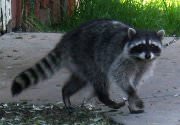
 Are you looking for a raccoon removal service because you have raccoons hanging around your property and need help get rid of raccoons?
Cute as they are, raccoons are not the kind of critter that you want to allow to hang out around your home all the time. They carry a dangerous disease, making getting rid of raccoons very important.
Call 281-961-0131 to get rid of Raccoons
As part of our wildlife animal control services, we provide humane raccoon removal in Houston, Austin, Dallas and Fort Worth.
The word “raccoon” is derived from a word that means “he who scratches with his hands.”
Raccoons are the most unusual critters. They have thumbs that make it easy for them to open garbage cans, doors, and other containers. They are one of the few animals that can climb down a tree head first. Amazingly, they turn their hind feet 180 degrees to do that.
Raccoons will eat anything. They are one of the few animals that have gained from human encroachment. You can now find them in more places than ever.
Rabies Makes Getting Rid Of Raccoons Essential
Raccoon rabies was much less prevalent in the U.S. prior to 1950. But during the next 20 years, raccoon rabies began to spread and reports increased, especially in Florida and Georgia.
In 1977, a variant of raccoon rabies distinct from the southern variant was detected in Virginia and West Virginia. This variant has since spread north along the eastern seaboard to Ontario, Canada.
According to a 2003 Purdue University newsletter: “There has been an increased number of rabies cases in domestic animals in the northeast due to raccoon rabies. Therefore, rabid raccoons could potentially lead to human exposure through rabid domestic animals.”
In 2003, the Centers for Disease Control & Prevention confirmed the first human death as a result of Raccoon Rabies.
The best way to stay safe is to stay away from wild animals, live or dead. This is very true with raccoons. If a raccoon looks sick, doesn’t move well, makes strange sounds, or is aggressive, get away and contact a raccoon removal service.
If you need to get rid of raccoons on your property, call Wilderness Animal Control immediately and we will schedule a time for raccoon trapping and removal. Our number is 281-961-0131.
If your pet is acting ill or strange, contact your veterinarian immediately.